fbpx

Freckles The Manta Goes Viral


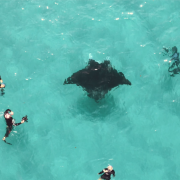
Once again – one of Seadog’s campaigns has achieved extraordinary results for a client. Our recent film for Tourism Western Australia (please watch below) features a group of divers and a manta ray named Freckles. The manta has a fishing hook embedded underneath her eye. She rolls over and repeatedly presents to wildlife guide Jake. After seeing how she would react to him being close to her, he is able to gently remove the hook.

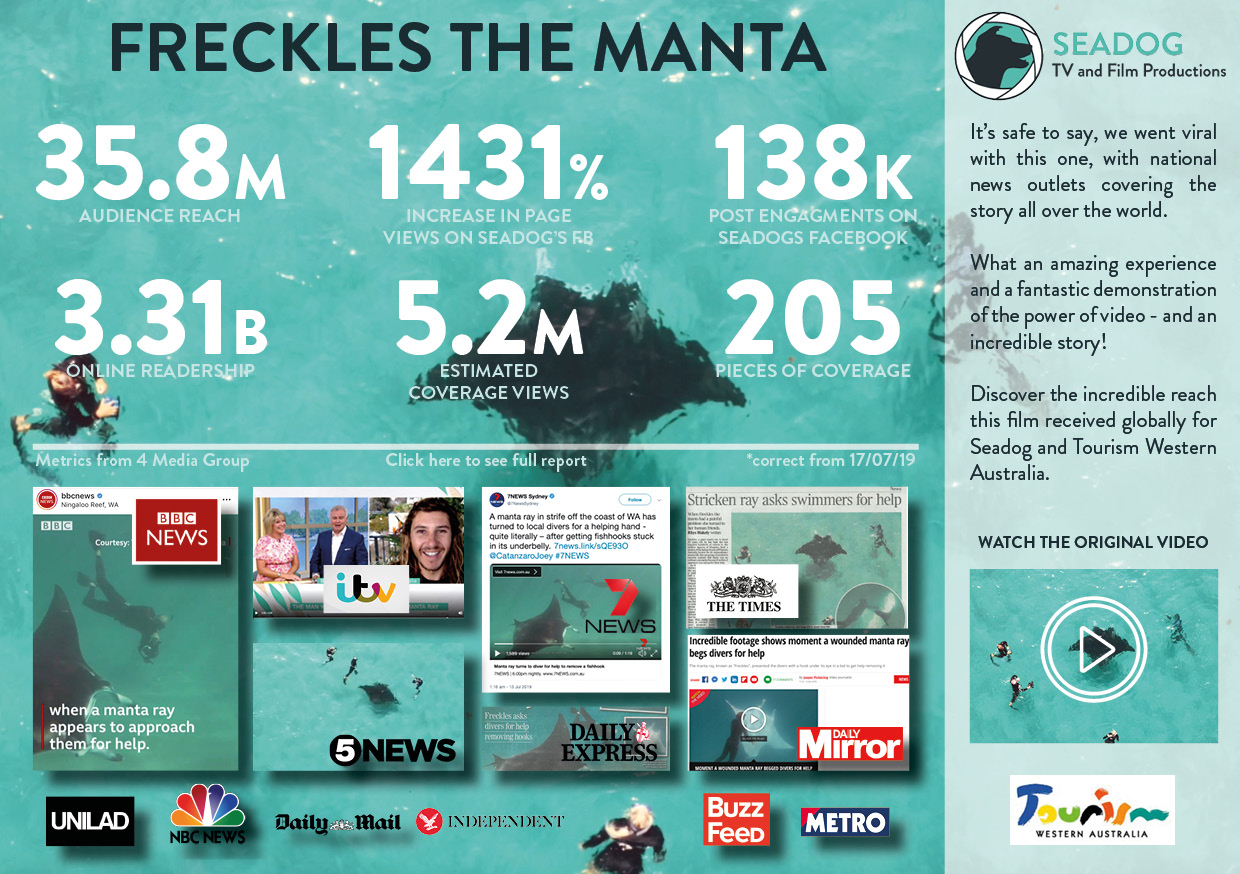
This incredible moment was beautifully captured by Seadog and has gone global, being picked up by over 200 publications around the world, including major newspapers, websites and tv channels. These serve 3.5 billion readers and viewers, and it has been shared 47,000 times on social media.

Just like our previous campaigns, these are unprecedented results for our client. They show the power of our storytelling skills, our production values, and our ability to understand what appeals to a universal audience. This is achieved by our bespoke approach using a small, highly-skilled team who create content that achieves notable ROI again and again.

This video is a fantastic example of how a compelling story featuring the values and topics your audience care about is the easiest way to keep them engaged.

We’ll be working with a limited number of brands and organisations in the next twelve months to achieve similar results. The above PDF speaks volumes about the impact we will have for these brands.

We’d love to meet and talk through what we can do for you in 2019 and beyond.

Do feel free to drop us a line, and we’d be happy to arrange a meeting.


The Film Making Process

The following steps outline our process, from initial phone call to launching your content. We work closely with you at every stage – it’s your film after all!


1. Initial phone call

We chat about your organisation and what you would like to achieve from a campaign. We’ll tell you about how we operate, our team and our initial thoughts on schedule, deadline and costs. We’ll ask:

  • What sort of video(s) you’d like – length, style and platform
  • Your objectives and target audience
  • If you’d like any supporting content – 360VR, photography, graphics
  • What locations, cast or talent you have in mind
  • If you have a deadline for the project
  • If you have a budget for the project – An indication of your budget will help us develop the proposals within your price range.

Don’t worry if you don’t know the answers to all of these questions. We just want to get a rough idea of how you envisage the end content looking and feeling. We can then work-up more solid ideas to meet your budget.


2. Seadog review

We chat to our cameraman, our editor and our producer to come up with a variety of options for you. We discuss how many filming days we think it will take, what locations are needed, what extras we think are needed in terms of graphics, props, equipment and contributors.


3. Email

We email you with our initial proposal, which will include our thoughts on styles, storylines, a schedule and a draft budget.


4. Production phone call

We go through the storyline with you and talk more about the schedule and budget. We agree all of these with you.


5. Agreement

We send you our Client Agreement Contract to sign – this details what we will deliver to you and when, agreeing locations, people and dates with you for the filming. We ask for 25% payment on signature.


6. Pre-production

Our producer writes a script for the film and send to you for approval. This will include thoughts on style.


7. Filming

We come and film!


8. Editing

Our editor edits the first draft of your film. How long this takes will depend on the length and style of your film.


9. First draft approval

We send you the first draft for you to watch. This first draft is just that, a first draft. It’s an assembly of your story, in the right order. It has rough music on it, and the sound levels might not be perfect. The picture may look a bit grey and washed out. Don’t panic! We fix all of that later – this is just for you to give your initial thoughts on what you think of the storyline and the style.

You need to feedback to us within 48hrs. If you are local to Bristol, we are happy to do this in person with you or can be over the phone or by email.


10. Editing

Our editor then incorporates your feedback into the film, creating a second draft.


11. Second draft approval

We send you the second draft for you to watch. This is almost the finished version. You need to feedback to us within 48hrs. Again, this can be in person, over the phone or by email.

This is your last chance to make any changes!


12. Editing

Our editor finishes the film, incorporating your second draft feedback and enhancing the colour and sound. We will then send it to you via Vimeo or WeTransfer, ready for your launch.

Oh, and we now send you an invoice for the balance! Sorry.


13. Launch

You launch your film, and we will link to your film and help promote it!


Send us your brief

What is 360° VR?

360° VR unlocks new dimensions of storytelling, creating immersive experiences which are more authentic, more interactive and more engaging.
But what is it?


(You might also like: 5 Reasons to Use 360° VR in Your Next Campaign’)


The Evolution of Story Telling
For millennia, we’ve been flattening our three-dimensional working into 2D stories and confining them to their designated platforms – paintings in galleries, music through the radio, print in books and magazines, films shown on screens. This allowed brands and businesses to choose where they targeted their audience and how they told their story.


But then came a game changer. With the advent of the internet the playing field was levelled, and consumption of media now happens in one place – online, carried around in people’s pockets. Organisations are now competing for attention in a bid to get their message across in one crowded market place.


Enter VR…

…and another game changer. VR headsets, increasingly affordable and accessible, allows users to not just consume media, but experience it. Unlike traditional film adverting, VR places the viewer in the middle of the film and adds an extra layer of immersion. Those who are utilising VR are one step ahead of thousands of others that are still confining themselves to 2D storytelling.


So, What is 360° VR?
There are two basic camps of virtual reality – cinematic (or 360°) and game engine based. These differ on the means of production, playback method, realism, and amount of interactivity allowed.

While VR was originally developed with gaming in mind, the 360° VR is all about immersive film content, with the action happening around the viewer. However, unlike in game engines, viewers cannot move around the scene freely beyond their 360° range of vision – only if the camera is moved during filming does the viewer move.


How Does 360° VR Work?
To create 360° VR, 360° cameras film in all directions at all times. The finished result allows the viewer to look around the scene as it unfolds. 360° 2D films can be viewed anywhere a ‘normal’ film can – on desktops, mobiles, tablets, virtual reality headsets and dome environments.

360° 3D films are created by replicating the same process as our eyes. Objects are filmed from two slightly different angles, using two cameras separated by the same distance as your eyes are.

These images are then aligned and viewed through head mounted devices (HMDs). The left eye sees the left image and the right eye, the right image. This gives the perception of depth and creates a more realistic experience. 360° 3D films can only be viewed in a virtual reality headset or dome environments, or on a phone if using a Google Cardboard headset.


Sensors in the head set track the movement of the user’s head, mapping the real-world movement to the user’s view of the virtual world. If the user turns their head to the left, the computer in the headset mimics the movement in the VR world. When done well, the user’s brain is tricked into thinking what it’s seeing is real, both on a conscious and subconscious level.


Do I need 360° VR?
Well, of course we’re going to say ‘yes’ (we can’t get enough of it at Seadog HQ), but it’s worth noting that big brands such as The New York Times, Google, Jaguar Land Rover and many more are all using 360° VR. Why? Read ‘5 Reasons to Use 360° VR in Your Next Campaign‘.



360 Case Study: Choose Your Own Adventure

Mountain climbing, sky diving, exploring ruins, white water rafting. These used to be pursuits exclusive to thrill seekers and adventurers.

The adventure travel market has made these experiences more and more accessible to the general public, but there are still millions of people who will never have the luxury, or perhaps the ability, to do so.

What
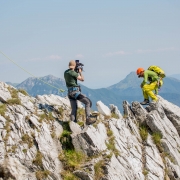
Choose Your Own Adventure experiences using 360VR provide endless opportunities to drop viewers of all abilities into immersive environments – imagine climbing a sea stack with a famous climber, flying with a wing suit into a Norwegian fjord, or simply driving an epic ocean highway with a famous personality.

Interactive features, such as information points and alternate routes can be added making an already immersive experience more engaging and highly shareable.


Where
Use short teasers on your social media channels, with the main experience hosted on your website or YouTube Channel. Get your own VR headset and they can be used at point of sale – in a ‘try-before-you by’ era, customers want to know what they’re getting before they get it.


Why
These films can take a digital marketing strategy to a whole new level, whether showcasing your brand values, as part of a CSR campaign to expand the experiences of those with disabilities or simply in order the drive traffic to your site from social media using the most engaging content out there.

They also open up new platforms set up specifically for VR material, that would otherwise be off-limits to your campaign, but available to the millions embracing this new platform.


Meet the Team

Seadog has a policy of employing young, talented creatives and combining this with experienced production veterans. As such, the company prides itself on nurturing new industry talent, whilst at the same time utilising relationships and experience that have been built up over many decades.


Monty Halls: Executive Producer

‘‘I like to flatter myself that I’m in charge, although I can’t help noticing that every time anyone wants a sensible answer they always go to Suze. I particularly enjoy the ability to work strategically, as the team are all so very capable in their particular areas that I can concentrate on the big picture, an absolute blessing for any boss.
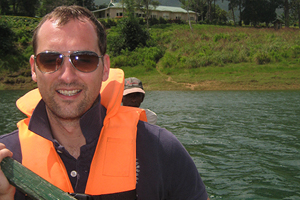
Outside of Seadog I am essentially a cash-point/cab driver/punch bag for my kids Isla and Molly, and enjoy spending time at home with the lovely (and endlessly patient) Tam. I also have an unhealthy obsession with rugby, love a surf, and am thoroughly looking forward to taking KP to the cleaners on our Ironman challenge in September this year.”


Mark Hale: Project Director

Mark is an experienced Project Manager, having learnt his trade within the UK Ministry of Defence. Wanting a change of scenery, Mark moved to the UAE to manage the design and construction of several multi-million-pound skyscrapers, collaborating with many of the World’s most renowned architectural practices.

In a change of career, he entered academia where he held a number of high-level management positions within the Country’s largest academic institution. Having recently returned to the UK with his young family, Mark has joined Seadog to manage their Creative branch and Leaderbox initiative.


Tamsyn Halls: Media and Communications Manager

Tamsyn has previously worked for the BBC, at Children In Need and the Wildlife Fund, organising live television appeals and running their marketing and PR efforts. She has also worked within production management at the Underwater Channel, where she gained valuable insight into the multi-platform online television industry, whilst utilising social media to build communities. Tamsyn’s passion is firmly based in the diving and wildlife sector and she’s also managed various events within these sectors, raising awareness and fundraising for numerous causes which aim to protect our natural world.


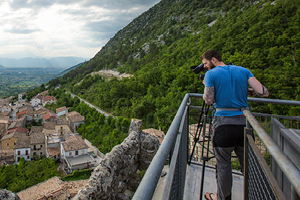
Rich Davies: Director of Photography 

‘‘In a nutshell, my job is to make our productions look as beautiful as possible. I am in charge of the visual elements within our films. Our directors and producers focus on story and character and then we collaborate to devise the best way to communicate that story.
I really enjoy my role as it allows me to be involved with every stage of the filmmaking process and takes me to some truly stunning places around the world. Seadog has a great ethos, allowing us a lot of room to roam creatively. What I most enjoy about my work is being part of a close-knit team of professionals who are all at the top of their game.’’


Stace Trevaskus: Development Executive

Stace has worked at a range of companies such as Hindsight Productions, Hat Trick & Plum Pictures, and joins Seadog after two years working at BBC Studios in London. She has worked across a range of developments and productions for major broadcasters such as BBC, ITV, C4, UKTV, Netflix and Youtube in everything from Entertainment to Docs. Having recently moved back home to the South West, Stace is hoping to immerse herself into the world of factual TV and help create some truly breathtaking stories.


© Copyright - Seadog Productions
Web Design by EUDS